|
|
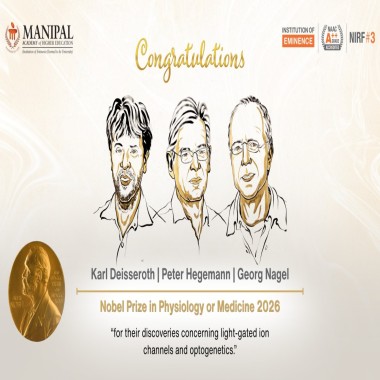
There is nothing more satisfying than to celebrate the discovery of ideas that can make a huge impact on human life. The 2026 The Nobel Prize in Physiology or Medicine goes to Karl Deisseroth, Peter Hegemann and Georg Nagel, "for their discoveries concerning light-gated ion channels and optogenetics." The laureates and the work Hegemann and Nagel discovered channelrhodopsin, a protein in a single-celled alga that opens an ion channel when blue light hits it. Deisseroth's group expressed that protein in nerve cells, turning a pulse of light into a command to fire. So essentially the award goes to optogenetics in which a light-sensitive protein is delivered into one chosen type of cell, so that light alone decides when those cells are active. MAHE expert insight Dr. Pavan Agrawal, PhD, Associate Professor at the Centre for Molecular Neurosciences, Department of Anatomy, Kasturba Medical College, MAHE got a sneak preview as he says, "I saw a piece of this up close." At HHMI Janelia Research Campus, USA, he was floor-mates with the team testing red-shifted channelrhodopsins in flies. One variant, CsChrimson, became the standard tool of the Drosophila field. Its sibling, ChrimsonR, is now being injected into human retinas in clinical trials to restore eyesight, says Dr Agrawal. On what the technique makes possible, he says: "In my lab we use these switches to study how social stress reshapes brain circuits, with sleep, aggression and courtship as readouts. Activating a circuit with light tells us whether it is sufficient to produce a behavior. Silencing the same circuit, which optogenetics also allows, tells us whether it is necessary. Getting both answers is where the real work lies." Why it matters For the medical community, this could mark a significant shift in how the brain is studied and how that knowledge can be translated into precise interventions. But beyond its medical implications lies something even more extraordinary: the glimpse it offers into what evolution has already solved. A protein that helps pond algae find sunlight is now being used to give eyesight back to people who have lost it. |